

A specification sheet for flexible packaging records what a supplier commits to on materials, product protection and safety. To be useful for sample approval and quote comparison, it should cover at least ten parameters: layer structure, thickness, grammage, oxygen transmission rate (OTR), water vapor transmission rate (WVTR), seal strength, laminate bond strength, coefficient of friction (COF), residual solvents and migration. Every value needs a test method, test conditions and a tolerance.
The most common gap is a missing test method. If two suppliers both claim "low OTR" or "strong seals" but measure differently, their numbers cannot be compared. Let’s go through each parameter with BMP Group: what it means, how to check it quickly, and what to ask your supplier.
Spec sheet, quotation and COA: three different documents
A quotation covers price, volume and lead time. A spec sheet is the technical commitment for one structure and becomes the acceptance standard. A Certificate of Analysis (COA) reports the measured results for a specific lot and is checked against the spec sheet.
It also helps to understand the structure being described. If you need a refresher, start with single-layer and laminated structures.
Material parameters: structure, thickness, grammage
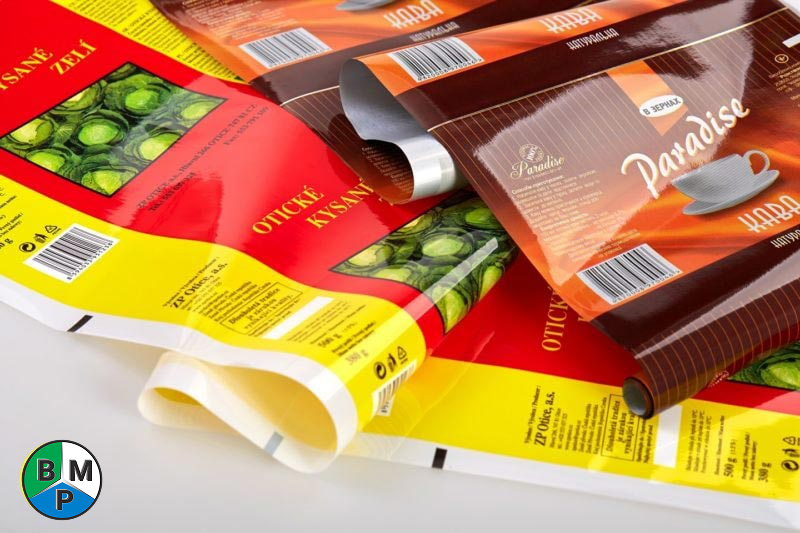
The layer structure is listed from outside to inside with the thickness of each layer, for example PET 12 µm / Al 7 µm / PE 80 µm. The outer layer usually carries the print, the middle layer provides the barrier, and the inner layer contacts the product and forms the seal. For background on what each packaging film does, see our overview. For the sealant, check whether it is PE or CPP film, since they differ in seal temperature window and heat resistance.
Total thickness (µm) and grammage (g/m²) should carry tolerances. Grammage drives how many pouches you get per kilogram of film, which is the number procurement needs to convert price per kg into price per pouch.
Barrier parameters: OTR and WVTR
OTR measures how much oxygen passes through the film, in cc/m²·day; under ASTM D3985 it is typically measured at 23 °C and 0% relative humidity. WVTR measures water vapor transmission in g/m²·day; under ASTM F1249 a common condition is 38 °C and 90% RH. Lower numbers mean better barrier.
Test conditions matter more than the headline number. Some barrier materials lose oxygen barrier as humidity rises, so a value measured at 0% RH may overstate performance for products stored or shipped through hot, humid climates. For long storage or tropical routes, ask for data at humid conditions as well.
Table 1. Barrier data a spec sheet should state
| Parameter | Unit | Reference method | Conditions to state | Most relevant for |
| OTR | cc/m²·day | ASTM D3985 | Temperature, RH (often 23 °C, 0% RH) | Coffee, milk powder, high-fat foods, pet food |
| WVTR | g/m²·day | ASTM F1249 | Temperature, RH (often 38 °C, 90% RH) | Snacks, biscuits, powdered seasoning, milk powder |
Table 2. Relative barrier of common layers (qualitative)
| Layer | Oxygen barrier | Moisture barrier | What to check |
| Aluminium foil | Very high | Very high | Pinholes and flex cracking after pouch forming |
| Metallized PET | High | High | Barrier depends on metal layer thickness |
| BOPA (nylon) | Fair | Low | Good puncture resistance; oxygen barrier drops when wet |
| BOPET | Medium | Medium | Common print layer |
| BOPP, PE, CPP | Low | Fair to good | Sealant or print layers; add a barrier layer for oxygen-sensitive products |
Mechanical and machinability parameters
These decide whether the film runs smoothly on your packing line and protects the product in transit. Test procedures are covered in our article on key laboratory QC tests.
- Seal strength: the force to separate a seal, in N/15 mm or N/25 mm, per ASTM F88. The spec should state the sealing conditions (temperature, pressure, dwell time) used to make the test sample.
- Bond strength: the force to separate laminate plies, prepared per ASTM F904. For oily, alcoholic or heat-treated products, ask for bond strength after product contact or after sterilization, not only on fresh film.
- Coefficient of friction: static and kinetic values per ASTM D1894. Too high and the film drags on form-fill-seal machines; too low and finished packs slide when stacked.
- Tensile strength and elongation: per ASTM D882, relevant to web tension on the machine.
Food safety parameters
Residual solvents from inks and adhesives affect odor and safety; the spec should state a limit and the method. Migration describes what can transfer from the packaging into food. For the EU market, Regulation (EU) No 10/2011 sets an overall migration limit of 10 mg per dm² of food contact surface, plus specific limits for individual substances. Ask for a Declaration of Compliance and migration results that match your food type. For Vietnam-specific requirements, see food packaging testing criteria and safety requirements for food packaging inks.
Checklist: 10 questions to ask when you receive a spec sheet
- Is every layer listed with its thickness?
- Do total thickness and grammage have tolerances?
- Are OTR and WVTR stated with method and test conditions?
- Do the test conditions resemble how the product is actually stored and shipped?
- Does seal strength state the sealing conditions used for testing?
- Is bond strength reported after product contact or heat treatment, where relevant?
- Are static and kinetic COF given, and which surfaces were tested?
- Is there a residual solvent limit?
- Is there a Declaration of Compliance and migration data for the destination market?
- Does the spec have a version number, issue date and approval signature?
Comparing two suppliers
Line up both spec sheets against the ten rows above. Where one supplier gives a number and the other only a description ("good barrier", "strong seal"), ask for data. Where the methods or conditions differ, do not conclude which is better yet. Then convert price per kg into price per pouch using grammage and pouch size; a lower price per kg is not cheaper if the film is heavier.
If you are moving to a more recyclable structure such as mono-material packaging, or need pouches that withstand sterilization such as retort packaging, compare the new spec against your current structure row by row, especially OTR, WVTR, seal strength and bond strength.
How BMP Group works with spec sheets
For new customers, the BMP Group team typically proposes a packaging structure design within 5 days, before sampling. The spec sheet is agreed before production and becomes the acceptance standard for every later lot.

BMP Group is one of Vietnam’s established manufacturers of flexible packaging and laminated films. We operate two plants in VSIP II-A (Binh Duong) and Tan Phu Trung (Cu Chi) with a combined capacity of 4,200 tonnes per month, producing millions of pouches every month. Our plants are certified to ISO 9001, ISO 15378, BRCGS Packaging Materials, FSC® Chain of Custody and ISCC PLUS, and we are ready to take on large-volume programmes and export packaging orders.
We work as a long-term, sustainable partner rather than just a supplier, developing packaging solutions that help you control cost and simplify operations. Get in touch: the BMP Group team is ready to support partners and customers in Vietnam and around the world.
See BMP Group’s certifications.
Contact us for packaging solutions that fit your needs:
- 1416 D1 Street, Phu Nhuan Residential Area, Phuoc Long Ward, Ho Chi Minh City, Vietnam
- +84 28 66 756 588
- Send us an enquiry